
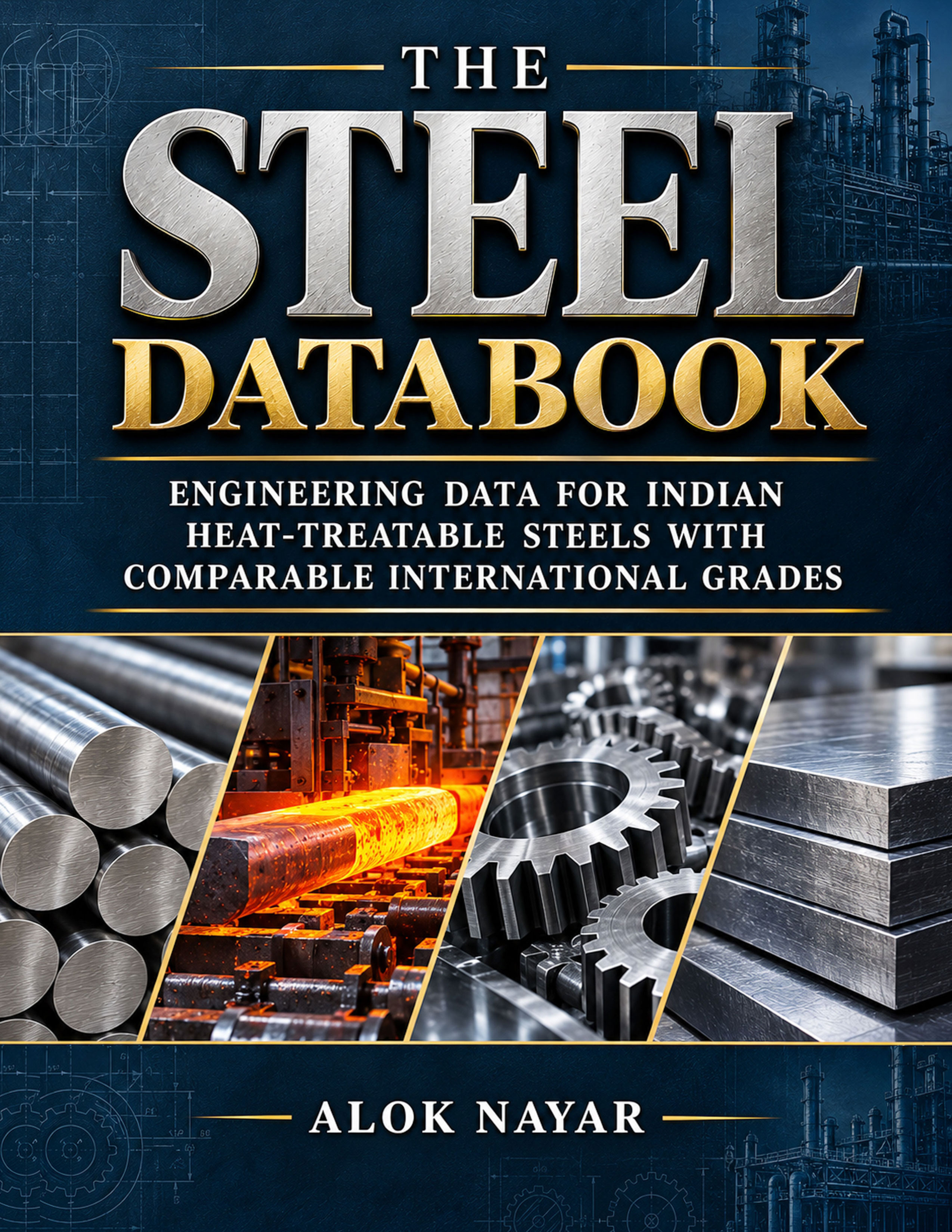
The Steel Databook : Engineering Data for Indian Heat-Treatable Steels with Comparable International Grades

Title: The Steel Databook : Engineering Data for Indian Heat-Treatable Steels with Comparable International Grades
Author: Alok Nayar
ISBN: 8119525256 / 9788119525256
Format: Hard Cover
Pages: 469
Publisher: Kojo Press
Year: 2027
Availability: Out of Stock
Forthcoming ...

Tab Article

The Steel Databook – Engineering Data for Indian Heat-Treatable Steels with Comparable International Grades contains 70 steel data sheets covering commonly used heat-treatable steel grades specified in Indian Standards. Each data sheet provides a comprehensive overview of the steel grade, including its description, typical applications, chemical composition, physical and mechanical properties, hardenability data, hot working temperature ranges, continuous-cooling-transformation (CCT) diagrams, heat treatment parameters, and information on cold shearability, machinability, and weldability. Comparable grades from international standards—such as ASTM, SAE, BS, CEN, DIN, GB/T, GOST, ISO, and JIS—are also included to facilitate global equivalence and cross-referencing.

In addition, the annexures at the end of the book provide supplementary metallurgical data to support practical application and deeper understanding.

This book is intended to serve as a reference for professionals involved in mechanical design, manufacturing, forming, and heat treatment of steels. It will also be useful to personnel engaged in materials procurement and in the localization of foreign specifications to Indian Standards.

The data presented in this publication has been compiled primarily from Indian Standards, along with selected information from ASTM, BS, DIN, CEN, and ISO standards, as well as authoritative reference books and technical publications issued by ASM International and various manufacturing organizations.

Tab Article

Acknowledgements
Preface

1 Classification of Steels
2 Designation System for Wrought Steels

3 Steel Data Sheets

Non-alloy steels – Plain carbon steels
3.1  10C4
3.2  14C6
3.3  15C8
3.4  20C8
3.5  25C8
3.6  30C8
3.7  35C8
3.8  40C8
3.9  45C8
3.10  50C8
3.11  55C6
3.12  55C8
3.13  65C6
3.14  70C6
3.15  75C6
3.16  80C6
3.17  85C6
3.18  98C6

Non-Alloy Steels – High-Manganese Carbon Steels
3.19  11C15
3.20  20C15
3.21  27C15
3.22  37C15
3.23  47C15

Non-Alloy Steels – Free-Cutting Steels
3.24  10C8S10
3.25  11C10S25
3.26   14C14S14
3.27  40C10S18
3.28  40C15S12

Alloy Steels – Silicon-Manganese Steels
3.29  37Mn5Si5
3.30  40Si7
3.31  55Si7
3.32  60Si7
3.33  65Si7

Alloy Steels – Silicon-Chromium Steels
3.34  55Si6Cr3

Alloy Steels – Manganese-Chromium Steels
3.35   16Mn5Cr4, 16Mn5Cr4-S
3.36  20Mn5Cr5, 20Mn5Cr5-S

Alloy Steels – Manganese-Molybdenum Steels
3.37  35Mn6Mo3
3.38   35Mn6Mo4

Alloy Steels – Chromium Steels
3.39  15Cr3, 15Cr3-S
3.40  40Cr4
3.41  50Cr4
3.42  55Cr3
3.43  100Cr6

Alloy Steels – Chromium-Molybdenum Steels

3.44  15Cr13Mo6
3.45  21Cr4Mo2
3.46  25Cr13Mo6
3.47  42Cr4Mo2

Alloy Steels – Chromium-Molybdenum-Vanadium Steels
3.48  40Cr13Mo10V2
3.49  52Cr4Mo2V1 (51CrMoV4)

Alloy Steels – Chromium-Aluminium-Molybdenum Steels
3.50  40Cr7Al10Mo2

Alloy Steels – Chromium-Vanadium Steels

3.51  42Cr6V1
3.52  50Cr4V2
3.53  58Cr4V1
3.54  60Cr4V2

Alloy Steels – Nickel Steels
3.55  40Ni14

Alloy Steels – Nickel-Chromium Steels
3.56  13Ni13Cr13
3.57  14Cr6Ni6, 14Cr6Ni6-S
3.58  16Ni3Cr2, 16Ni3Cr2-S
3.59  17Cr6Ni6
3.60  30Ni16Cr5
3.61  35Ni5Cr2

Alloy Steels – Nickel-Molybdenum Steels
3.62  20Ni7Mo2, 20Ni7Mo2-S

Alloy Steels – Nickel-Chromium-Molybdenum Steels
3.63  15Ni5Cr4Mo1, 15Ni5Cr4Mo1-S
3.64  15Ni7Cr4Mo2, 15Ni7Cr4Mo2-S
3.65  20Ni2Cr2Mo2, 20Ni2Cr2Mo2-S
3.66  20Ni7Cr2Mo2, 20Ni7Cr2Mo2-S
3.67  31Ni10Cr3Mo6
3.68  40Ni6Cr4Mo2
3.69  40Ni6Cr4Mo3
3.70  40Ni10Cr3Mo6

References

Annexures
Annexure A : Permissible Deviations between the Product Analysis and the Limiting Values given for the Cast Analysis
Annexure B : Ruling Sections for Mechanical Properties
Annexure C : How to use the Modified Continuous-Cooling-Transformation (CCT) Diagram
Annexure D : Patenting
Annexure E : Spheroidizing
Annexure F : Stress Relieving
Annexure G : Relationship of Carbon Content to Minimum Surface Hardness Attainable by Flame or Induction Heating and Water Quenching
Annexure H : Effect of Carburizing Temperature and Carburizing Time on Case Hardening Depth
Annexure I : Effect of Gas Carbonitriding Temperature and Carbonitriding Time on Effective Case Depth
Annexure J : Effect of Nitriding Time on Effective Case Depth
Annexure K : Minimum 0.2% Proof Strength of Steels for Quenching and Tempering in the Quenched and Tempered Condition
Annexure L : Minimum Tensile Strength and Hardness of Case-Hardening Steels in the Blank Carburized, Quench Hardened, and Tempered Condition
Annexure M : Carburizing and Carbonitriding – Simple Rules for Selection of Case Hardening Depth (CHD)
Annexure N : Useful Heat Treatment Standards
Annexure O : Useful Online Metallurgical Resources
Annexure P : Leading Steel Producers in India
Index

Tab Article

About the Author

Alok Nayar is a metallurgical engineer with over 34 years of experience in the metals industry. He earned a B.Tech. in Metallurgical Engineering from IIT Kharagpur and an M.S. in Materials Science from the University of Minnesota. He is the author of The Metals Databook (1997), The Steel Handbook (2002), and Testing of Metals (2005), published by Tata McGraw-Hill Publishing Company Limited, and served as co-editor of the proceedings volume Continuous Casting of Steel (1984), published by the Indian Institute of Metals. He is currently the editor of Alloy Digest, a publication of ASM International.