
Tab Article
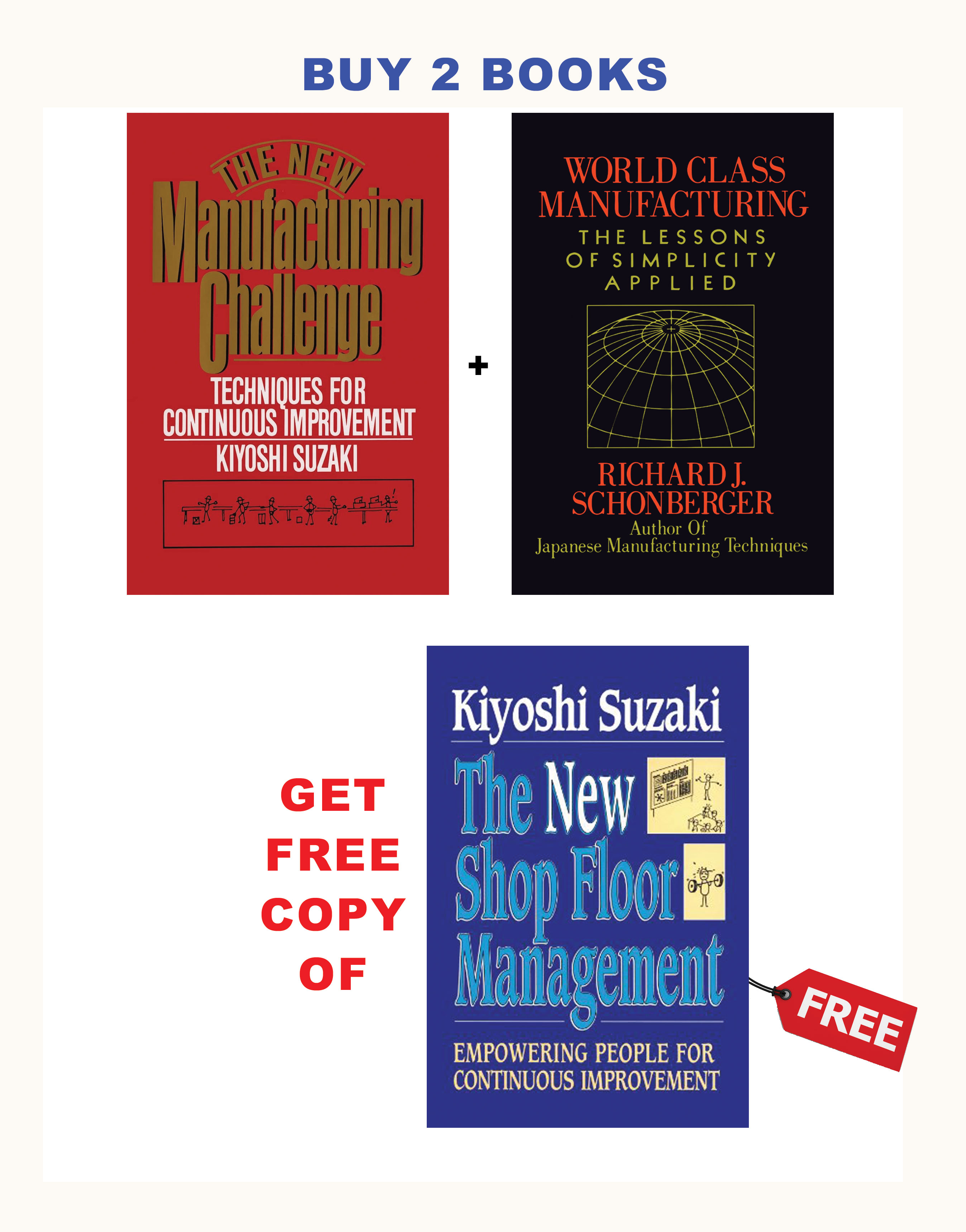
The New Manufacturing Challenge : Techniques for Continuous Improvement
As a consultant, Kiyoshi Suzaki has helped scores of Fortune 500 clients improve manufacturing operations and get the job done faster, cheaper, better, and safer. Now, in this detailed "operating manual" -- full of more step-by-step applications than any other book available -- Suzaki spells out new options in production and employee resources that can help American industry regain the cutting edge in price, quality, and delivery of products.
A well-known expert in the field, Suzaki begins with the premise that "if it doesn't add value, it's waste" -- a concept devised by Henry Ford and later used by Toyota. He recaps what Toyota identifies as the seven most prominent forms of waste in factories. Most importantly, he meticulously details steps individuals can take to "simplify, combine, and eliminate operations" -- thereby reducing waste, improving quality, and saving money.
Describing in detail the basic techniques culled from Japanese industrial philosophy and procedure, Suzaki shows how small, family-run businesses and billion-dollar American corporations from a wide range of industries -- automotive, electronics, cosmetics, and even defense contractors -- are meeting the manufacturing challenge today -- demolishing the widely held belief that most American manufacturers have become distribution organizations for products manufactured overseas. In addition, he links his methodology with several successful production systems, from Just-In-Time Production, Total Quality Control, Total Productive Maintenance to Computer Integrated Manufacturing. Throughout this practical handbook, he places emphasis squarely on the shop floor and grounds his approach in easy, yet powerful techniques everybody can understand and implement today.
Illustrated with numerous charts and exhibits, The New Manufacturing Challenge shows how to integrate people and techniques to improve the workplace and, thus, strengthen any company's competitiveness in the global marketplace.
World Class Manufacturing : The Lessons of Simplicity Applied
In his best-selling book Japanese Manufacturing Techniques, Richard J. Schonberger revolutionized American manufacturing theory and, more important, practice. In that breakthrough book, he revealed that Japanese manufacturing excellence was not culturally bound. Offering the first demystified explanation of the simple techniques that fueled Japan's industrial success, he demonstrated how the same methods could be put to work as effectively in U.S. plants.
Now, in World Class Manufacturing, Schonberger returns to tell the success stories of nearly 100 American corporations -- including Hewlett-Packard, Harley-Davidson, General Motors, Honeywell, and Uniroyal -- that have adopted the famed just-in-time production and "total quality control" strategies. Based on his firsthand experience as a major consultant to American industry, he examines how they did it -- and illustrates how the same concrete, specific steps used by these top companies can be implemented in any factory today. What's more, Schonberger shows that his bold concepts and reforms apply equally to all industries, whether the product is computers, pasta, or trucks, and to all divisions -- from manufacturing and engineering to accounting and marketing.
According to Schonberger, world-class manufacturing depends on blended management -- rather than domination by a separate group of managers -- which marshalls resources for continual rapid improvement. To achieve world-class status, companies must change procedures and concepts, which in turn leads to recasting relations among suppliers, purchasers, producers, and customers. Acknowledging the difficulty inherent in such changes, Schonberger stresses that employee involvement and interaction, both on the shop floor and in the decision-making/problem-solving process, is key. Wary of those who view improvement in terms of modernizing equipment, he points out that making maximum use of people and current machinery is a company's first priority; automation, if necessary, should come much later.
World Class Manufacturing also includes Schonberger's 17-point action agenda to guide innovators toward manufacturing excellence, from getting to know the customer to cutting the number of suppliers, reducing error in production, and deciding when and how to automate.